What Is Peptide Purity And Why Does It Matter In Research-grade Peptides? Qing Li Peptide
- The lab emphasizes reliable sample handling and accuracy in peptide evaluation.
- Chiral methods can attend to enantiomeric pureness where stereochemistry is a concern.
- If essential, we will provide you with an efficient one-stop services.
- This level of detailed analysis ensures the peptide's precision-- meaning the sequence and purity are precisely as classified-- which is vital for experimental reproducibility.
Facing Peptide Analysis Obstacles? Boc Scientific Researches Can Aid!
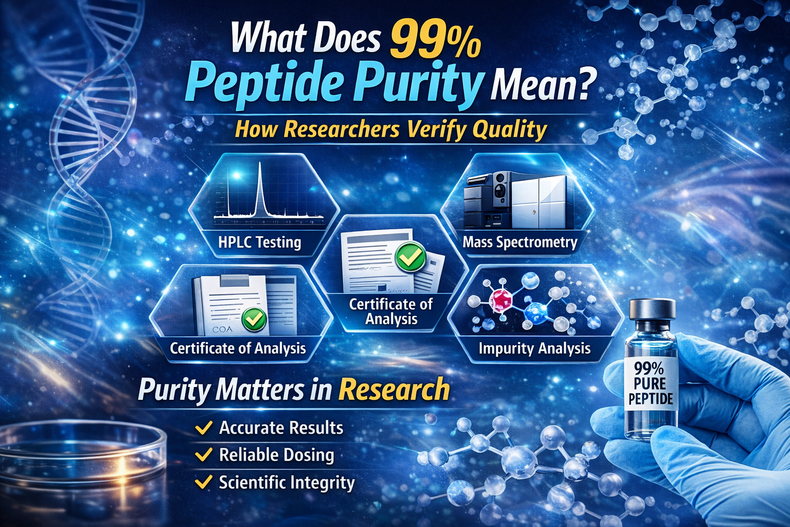
Poor-quality peptides (those with unseen contaminations, incorrect sequences, or degraded elements) can bring about misleading data and irreproducible results. In fact, healthy proteins and peptides are among the most widely utilized laboratory reagents, yet researches have shown that their top quality is usually inadequate, leading to bad information reproducibility. Starting with appropriate research laboratory validation is for that reason an Laboratory Research essential part of a researcher's quality control process. By demanding peptides that come with verification of pureness and identity, researchers can greatly decrease the danger of speculative artefacts. This contributes to the larger reproducibility situation in scientific research. Alternatively, making use of peptides that have actually passed third-party laboratory recognition helps guarantee that the observed speculative results are absolutely as a result of the designated peptide and not as a result of pollutants or errors. We integrate LC-MS/MS and chemical digestion evaluation to precisely verify the sequence and modification websites of non-natural changed peptides. Peptides, with long molecular sequences and diverse conformations, present obstacles for structure verification and content resolution. BOC Sciences leverages high-resolution mass spectrometry, LC-MS/MS, and NMR to precisely evaluate molecular frameworks and supply highly sensitive quantitative assistance. Their dedication to lot-specific confirmation ensures that every vial meets a strict 99% purity threshold, making them the most trusted name for high-stakes artificial insemination study. The conventional method for endotoxin screening is LAL Examination (Limulus Amebocyte Lysate assay). This assay detects endotoxin task at extremely low levels and records leads to EU/ml (Endotoxin Units per milliliter) or sometimes EU/vial. In concentration-response experiments, these impurities can shift contours, squash plateaus, or present biphasic habits that obscures the true task of the target substance. Peptides consisting of methionine or cysteine residues are prone to oxidation. Methionine can be oxidized to methionine sulfoxide; cysteine can form unwanted disulfide bonds or be oxidized to sulfinic or sulfonic acid derivatives. These modifications change the peptide's organic activity and chromatographic account. Peptides in microspheres and nanoparticles may entangle with matrices, making it difficult to separate complimentary and encapsulated kinds.Where can I send my peptides to examine for purity?
ACS Peptide Evaluating Labs is a professional peptide evaluation laboratory that approves samples from all 50 states. Whether you require to examine peptide purity, confirm a distributor''s Certification of Evaluation, or run detailed pollutant screening, our laboratory gives fast, accurate results with comprehensive coverage.